
Introduction
Maruti Suzuki India Limited has once again demonstrated why it remains the undisputed leader of India’s automotive industry. While the company is widely known for producing reliable, fuel-efficient, and affordable vehicles, its latest achievement goes beyond manufacturing. Maruti Suzuki is now reshaping how automobiles are delivered across the country, setting new benchmarks in sustainable and future-ready logistics.
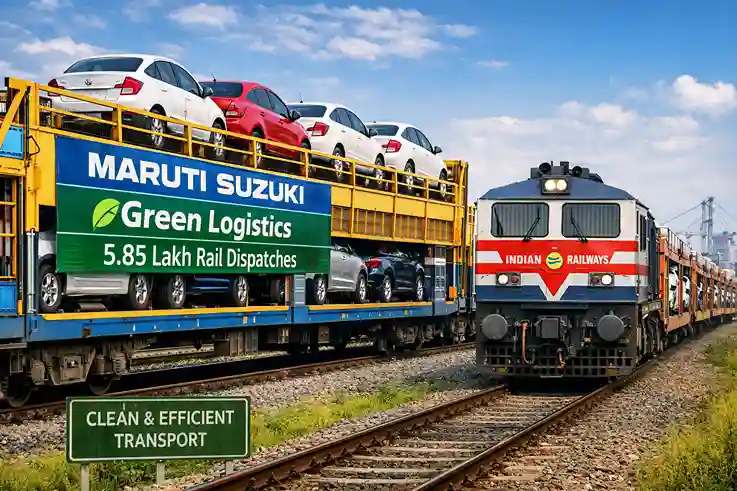
By dispatching a remarkable 5.85 lakh vehicles through rail transport in a single year, the company has created a historic milestone in Green Logistics. This initiative highlights how large-scale industrial operations can grow responsibly while significantly reducing their environmental impact.
A Record-Breaking Milestone in Indian Auto Logistics
The scale of this achievement is unprecedented in the Indian automobile sector. The 5.85 lakh rail dispatch figure is the highest ever recorded by any car manufacturer in the country.
What makes this milestone even more impressive is the strong year-on-year growth. This marks a nearly 30% increase from the 4.35 lakh units dispatched via rail in the previous year, clearly reflecting Maruti Suzuki’s accelerated shift away from road-based transportation.
By leveraging the vast infrastructure of Indian Railways, the company ensures that vehicles manufactured at its plants in Haryana and Gujarat reach dealerships efficiently across India. From metro cities to remote regions, rail transport enables faster, safer, and more predictable delivery timelines, strengthening dealer networks and customer satisfaction alike.
Why Green Logistics Matters More Than Ever
In today’s global business environment, sustainability is no longer just an option—it is a core corporate responsibility. Traditional road-based vehicle transportation relies heavily on thousands of trucks, leading to higher fuel consumption, increased greenhouse gas emissions, and severe congestion on national highways.
Rail-based logistics offers a practical and scalable solution to these challenges, especially in a country as large and diverse as India.
Key Benefits of Rail-Based Dispatches
Lower Carbon Footprint
Rail transport emits substantially less CO₂ per vehicle compared to road transport. Maruti Suzuki’s rail dispatch strategy is estimated to offset over 10,000 tonnes of CO₂ emissions, making a meaningful contribution to India’s climate commitments.High Energy Efficiency
A single automobile freight train can carry hundreds of cars in one journey, consuming far less fuel than a large convoy of trucks.Damage-Free Transportation
Specially designed automobile wagons reduce handling risks, significantly lowering the chances of scratches, dents, or transit damage compared to road movement.Reduced Highway Congestion
By shifting lakhs of vehicles to rail, thousands of truck trips are removed from highways each year, improving road safety and easing traffic pressure.
Strong Partnership with Indian Railways
Maruti Suzuki’s success in rail logistics is built on a long-standing and strategic partnership with Indian Railways. Notably, the company became the first automobile manufacturer in India to receive the Automobile Freight Train Operator (AFTO) license.
This landmark step allowed Maruti Suzuki to invest in custom-built, high-capacity automobile rakes, specifically engineered for safe, efficient, and large-scale vehicle transportation. These wagons not only improve logistics efficiency but also enhance reliability across long-distance routes.
The Road (and Rail) Ahead: A Multimodal Logistics Vision
Maruti Suzuki’s sustainability strategy does not stop at rail transport. The company is actively expanding its multimodal logistics network, integrating coastal shipping and waterways alongside rail and road transport.
By using coastal shipping routes, Maruti Suzuki aims to further reduce emissions, especially for long-distance movement and port-linked dispatches. This multimodal approach allows the company to optimize costs, minimize fuel usage, and build a logistics ecosystem that is both resilient and environmentally responsible.
Such initiatives are particularly aligned with India’s broader vision of developing greener freight corridors and promoting alternative transport modes.
Did You Know?
Maruti Suzuki’s commitment to sustainability extends beyond logistics. The company has made significant investments in renewable energy, including large-scale solar power plants at its manufacturing facilities.
These solar installations help power factory operations with clean energy, reducing dependence on conventional electricity sources and lowering overall carbon emissions. By combining green manufacturing with green logistics, Maruti Suzuki is embedding sustainability across its entire value chain.
Conclusion
Maruti Suzuki’s record 5.85 lakh rail dispatches represent far more than a logistics achievement. They signal a fundamental shift in how India’s automobile industry can balance growth with environmental responsibility.
From improved delivery efficiency and reduced transit damage to lower emissions and decongested highways, the benefits of this initiative extend well beyond the company itself. As India moves steadily toward its Net Zero ambitions, such leadership-driven efforts set a powerful example for the entire manufacturing sector.
Maruti Suzuki’s journey proves that “Make in India” can also mean “Move Green in India.”