
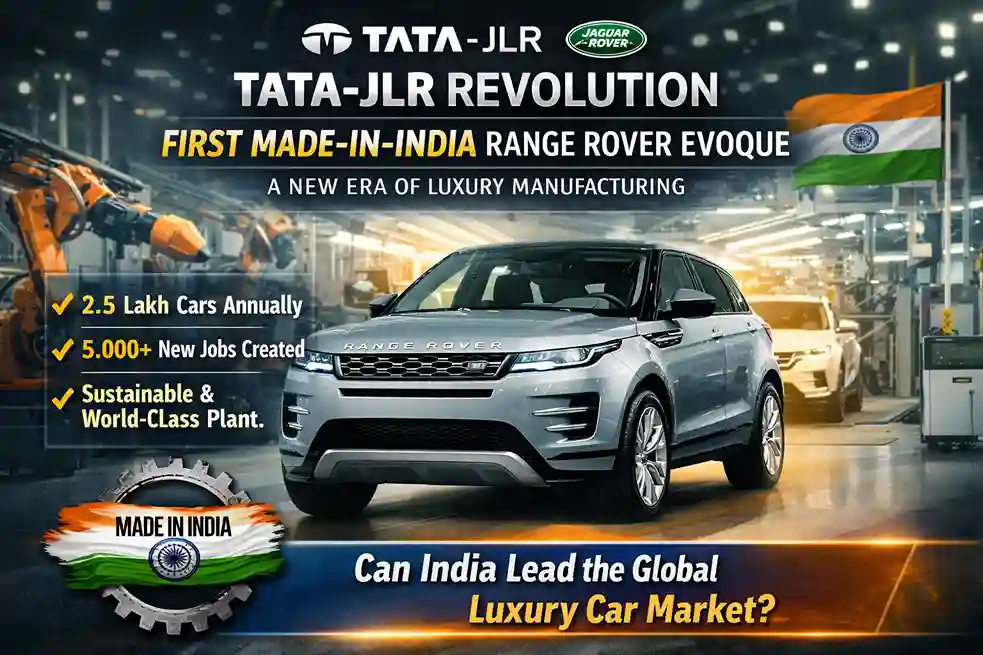
India’s automotive industry has reached a defining moment. The first Range Rover Evoque has officially rolled out from the newly inaugurated, state-of-the-art manufacturing facility operated by Tata Motors in partnership with Jaguar Land Rover.
This is not just another model launch—it is a strategic milestone that firmly places India on the global map of luxury vehicle manufacturing.
Key Highlights at a Glance
Before diving deeper, here are the most important takeaways from this landmark development:
Annual Production Target: Up to 2.5 lakh luxury vehicles
Employment Generation: Around 5,000 direct jobs
First Model Rolled Out: Range Rover Evoque (Made in India)
These numbers alone underline the scale and ambition behind the Tata–JLR collaboration.
Redefining ‘Make in India’ for the Luxury Segment
For years, premium SUVs were largely associated with imports or semi-knocked-down (SKD) assemblies. The localization of the Range Rover Evoque changes that narrative decisively. It proves that Indian manufacturing can meet—and match—the exacting global standards of the iconic “Green Oval” brand.
Built on the same quality benchmarks followed at JLR’s global facilities, this plant reflects a powerful alignment with the Make in India vision. India is no longer just a fast-growing luxury market; it is now a trusted production base.
Built for Scale, Precision, and the Future
The new Tata–JLR facility has been designed with long-term scalability at its core. With a planned capacity of 2.5 lakh vehicles per year, it stands among the largest luxury automotive hubs in the region.
Advanced robotics, AI-driven quality control systems, and precision engineering processes ensure that every vehicle leaving the line meets global luxury standards. This is not mass production—it is premium manufacturing at scale.
Powering Growth: 5,000 Jobs and a Strong Supply Chain
The true impact of this plant goes far beyond automobiles.
Direct Employment
The facility is expected to generate 5,000 direct jobs, spanning advanced manufacturing, engineering, quality assurance, and operations. These roles emphasize skill development and exposure to cutting-edge automotive technologies.
Indirect Opportunities
From local component suppliers to logistics and service partners, the extended ecosystem is likely to create thousands of indirect jobs—making this plant a major economic catalyst for the region.
Sustainability at the Core of Manufacturing
Modern luxury manufacturing is not only about performance and design—it is also about responsibility. Sustainability plays a central role in the Tata–JLR vision for this facility.
The plant focuses on green manufacturing practices, with an emphasis on reducing carbon footprint, optimizing energy use, and minimizing waste. More importantly, it is being developed as a future-ready base for electric vehicles (EVs), aligning with JLR’s global electrification roadmap and India’s long-term sustainability goals.
What This Means for Indian Luxury Car Buyers
Local production of the Evoque delivers clear advantages for customers:
Shorter Delivery Timelines: Reduced dependence on imports cuts waiting periods.
Competitive Pricing Potential: Optimized logistics and tax structures allow greater pricing flexibility.
Global Quality Assurance: Vehicles undergo the same stringent testing as those produced in Solihull, UK.
Competitive Landscape
This move also intensifies competition in India’s luxury SUV segment. Locally manufactured Range Rover models are set to challenge established players like BMW and Mercedes-Benz, adding a strong business and pricing edge to JLR’s India strategy.
The Road Ahead
The rollout of the Evoque is only the beginning. With significant unused capacity and flexible production lines, the plant is well-positioned to host more iconic JLR nameplates in the future—potentially even catering to exports.
This signals a long-term commitment: India is evolving from a luxury consumption market into a global manufacturing and export hub.
Conclusion: India’s Luxury Manufacturing Moment Has Arrived
The Tata–JLR revolution represents a powerful blend of British luxury heritage and Indian industrial capability. As production ramps up, this facility will not only shape the future of premium mobility but also strengthen India’s standing in the global automotive value chain.
The first Made-in-India Range Rover Evoque carries more than a prestigious badge—it carries the aspirations of thousands of skilled workers and the confidence of a nation ready to lead.