
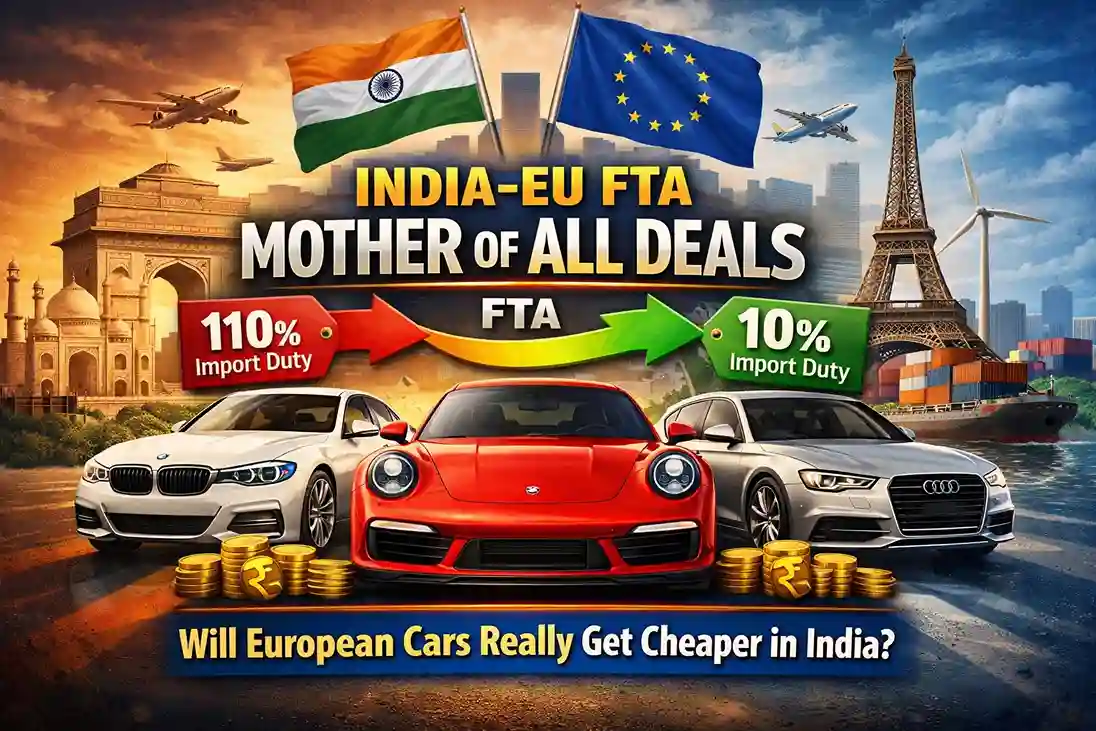
A Landmark Agreement That Goes Far Beyond Headlines
In January 2026, India and the European Union signed one of the most significant Free Trade Agreements (FTA) in India’s economic history. Popularly branded as the “Mother of All Deals,” this agreement has generated massive excitement—especially in the automobile sector. The core reason is simple: for the first time, India has agreed to meaningfully reduce the extremely high import duties imposed on European cars.
However, this deal is not about overnight discounts or sudden market flooding. It is a carefully structured, long-term roadmap that balances consumer interest, domestic industry protection, and global competitiveness.
The big question remains:
Will European cars actually become affordable for Indian buyers, or is this just headline hype?
This article breaks down the numbers, policy logic, case studies, and long-term consequences—so you see the full picture, not just the excitement.
Understanding the FTA Framework: Why This Deal Is Strategic, Not Emotional
The automotive chapter of the India–EU FTA has been designed with precision. The government’s objectives are clear:
Open India’s premium and luxury car market gradually
Protect domestic automakers from sudden disruption
Encourage technology transfer and global model availability
That is why the deal is phased, conditional, and quota-based, rather than a blanket duty cut.
Import Duty Explained: From 110% to 10%, But Over Time
Before the FTA, fully built European cars (CBUs) attracted basic customs duties ranging from 70% to 110%. This is why a car costing ₹45–50 lakh in Europe often crossed ₹1 crore in India.
The New Duty Roadmap
Immediate Phase (2026):
Import duty reduced to around 40%Medium-Term Phase (Next 5 Years):
Gradual, step-by-step reductionsLong-Term Target (Up to 10 Years):
Approximately 10% basic customs duty
This gradual approach provides pricing predictability to both buyers and manufacturers.
Quota System: Controlled Access, Not Unlimited Imports
One of the most important safeguards in the FTA is the quota mechanism.
Only 2,50,000 European cars per year will qualify for reduced duties
This prevents uncontrolled imports and protects domestic production
In simple terms:
Cars will become cheaper
But availability will remain disciplined
Price Threshold Rule: Not Every European Car Qualifies
Another critical protection clause ensures that Indian mass-market cars are not threatened.
Eligibility Condition
Reduced duty applies only to cars with a CIF value above $15,000
(Approximately ₹13.5–15 lakh)
This means:
Budget European cars are excluded
Benefits are focused on premium and luxury segments only
Before vs After: A Clear Comparative Snapshot
| Factor | Pre-FTA (Old System) | Post-FTA (Long Term – 10 Years) |
|---|---|---|
| Basic Customs Duty | 70% – 110% | ~10% |
| Eligible Cars | All CBU cars | Only CIF > $15,000 |
| EV Imports | High duty | No change for 5–7 years |
| Annual Availability | Unlimited but expensive | Limited (2.5 lakh units/year) |
| Price Predictability | Low | High |
This clearly shows that the FTA promotes smart liberalisation, not reckless imports.
Case Study: Porsche 911 – What the Numbers Really Say
Let’s look at a hypothetical but realistic example.
CIF Value: ₹1 crore
Old System
Import duty (110%) ≈ ₹1.1 crore
Landed cost ≈ ₹2.1 crore (excluding GST & cess escalation)
FTA Long-Term Scenario
Import duty (~10%) ≈ ₹10–12 lakh
Landed cost ≈ ₹1.3–1.4 crore (including taxes)
Potential difference: ₹70–80 lakh over a 10-year horizon
This example explains why enthusiasts are excited—not for instant discounts, but for long-term correction.
Which European Brands Benefit the Most?
Luxury and Performance Brands (Biggest Winners)
BMW
Mercedes-Benz
Audi
Porsche, Ferrari, Lamborghini
Their fully imported (CBU) models will see the maximum impact.
Premium Enthusiast Brands
Volkswagen
Škoda
Cars like the Octavia RS or Golf GTI may finally achieve realistic pricing for Indian enthusiasts.
Rules of Origin: Why “Made in Europe” Must Be Genuine
A crucial but often ignored aspect of the FTA is Rules of Origin.
Key Requirement
At least 35–45% value addition must take place within Europe
Simple assembly in Europe using Chinese components will not qualify
This clause:
Protects India’s trade balance
Reduces strategic dependency
Ensures only genuine European manufacturing benefits
Also Read :- Range Rover Sport vs Defender 130: Which Luxury SUV to Buy in 2026?

Electric Vehicles: Why EV Imports Are Still Protected
Despite excitement around European EVs, the FTA takes a cautious approach.
No duty reduction for EVs for the next 5–7 years
Gradual opening may begin post-2031
This protection allows companies like:
Tata Motors
Mahindra
to strengthen India’s domestic EV ecosystem.
Impact on the Used Luxury Car Market: A Silent Shift
As new luxury cars become relatively cheaper:
Resale values will naturally adjust
Used BMW, Mercedes, and Audi models will become more affordable
This creates a new entry point for mid-segment buyers and expands India’s pre-owned luxury market significantly.
Infrastructure & Service Network: The Real Stress Test
Cheaper cars alone are not enough.
Key questions remain:
Will European brands expand service networks into Tier-2 and Tier-3 cities?
Will trained technicians and spare parts availability keep pace with rising sales?
Without strong after-sales infrastructure, customer experience could suffer—making this FTA a full ecosystem challenge, not just a pricing exercise.
Reality Check: Why “Half-Price Cars” Is a Myth
Rupee depreciation against the Euro can dilute benefits
GST (28%) and compensation cess (up to 22%) still apply
Locally assembled (CKD) luxury cars will see limited impact
So yes—prices will fall, but not in a dramatic overnight fashion.
Conclusion: A Golden Decade for Indian Auto Consumers
The India–EU FTA is not about instant gratification. It is about structured evolution.
Over the next 10 years:
Global models will reach India
Competition will intensify
Technology, safety, and pricing transparency will improve
European cars may not become “cheap,” but they will become fairly priced.
And in any competitive market—
the ultimate winner is always the consumer. 🚗✨