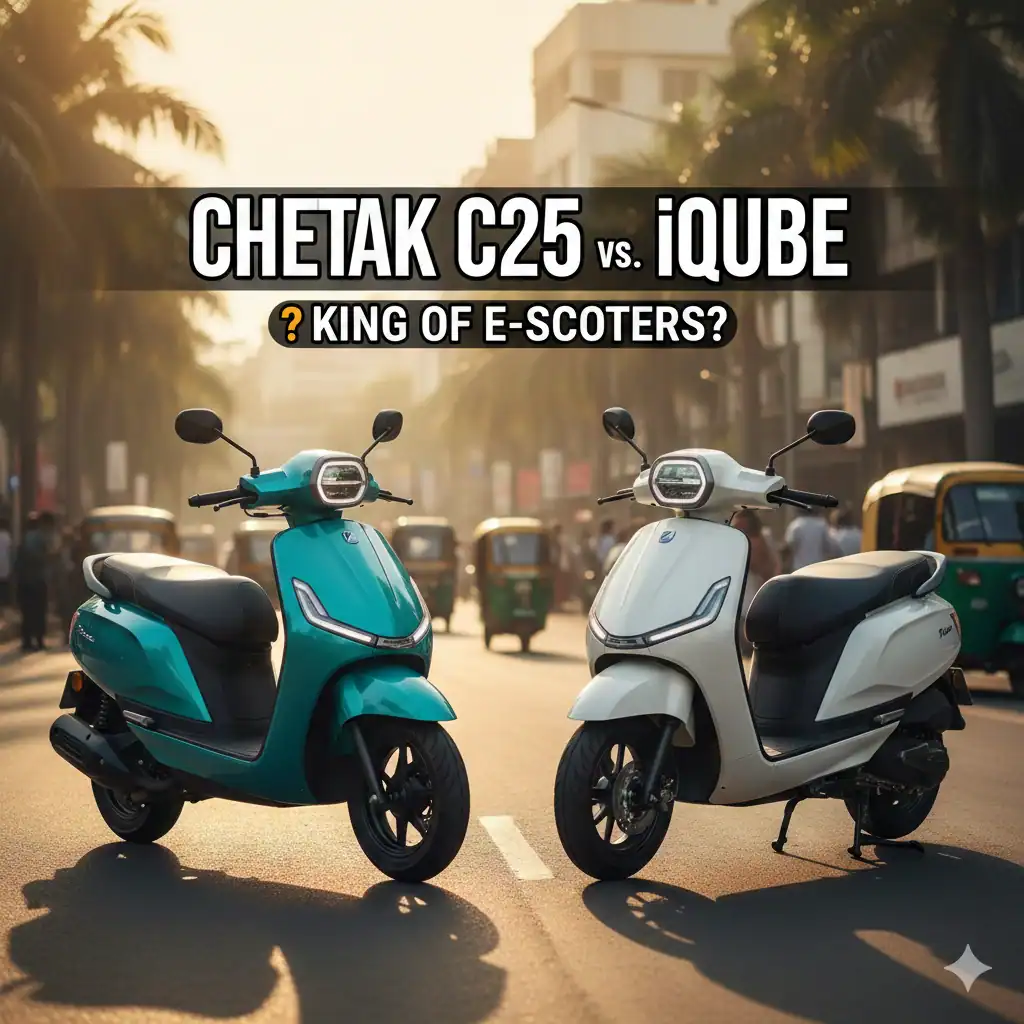
The electric scooter war in India has just reached a boiling point! For years, the TVS iQube has been the silent favorite for families, while the Bajaj Chetak won hearts with its “Hamara Bajaj” nostalgia and solid metal build.
But as we step into 2026, Bajaj has dropped a bombshell: the new Bajaj Chetak C25 (2025-26 model). With a more aggressive price tag and a fresh “C-series” identity, everyone is asking the same question: Has Bajaj finally built the iQube-killer?
Let’s dive deep into the ultimate battle of the 2025-2026 electric scooter titans.
1. Design & Build: Metal vs. Modern
The first thing you notice about the Chetak C25 is its signature all-metal body. In a market filled with plastic panels, the Chetak feels like a tank. The 2025 update brings subtle but premium changes:
New “Ice Cube” LED Tail Light: A sleek, horizontal light bar that looks much more futuristic than the old split setup.
Repositioned Indicators: Now mounted on the handlebar for better visibility.
Vibrant Colors: From Misty Yellow to Ocean Teal, it’s clearly targeting a younger audience now.
On the other hand, the TVS iQube remains the king of “sensible” design. It looks like a traditional scooter, making it very approachable for parents. However, its high-quality plastic body—while durable—just doesn’t give that “heavy-duty” feel of the Chetak.
2. Performance & The “Hub Motor” Shift
This is where the game changes. Historically, Chetak used a mid-drive motor. The new C25 variant is the first in the family to use a 2.2 kW Hub-Mounted Motor.
| Feature | Bajaj Chetak C25 | TVS iQube (Base) |
| Top Speed | 55 kmph | 75 kmph |
| Peak Power | 2.2 kW | 4.4 kW |
| Ride Modes | Eco & Sports | Eco & Power |
The Verdict on Speed: If you want a “zippy” scooter, the TVS iQube still wins with a higher top speed. However, the Chetak C25 is tuned for efficiency and city crawling, making it a perfect second vehicle for errands or short office commutes.
3. Range & Battery: The Real World Battle
Range anxiety is real, and both brands have addressed it differently. The Chetak C25 comes with a 2.5 kWh NMC battery, promising an IDC range of 113 km. In real-world conditions, you can expect a solid 90 km.
The TVS iQube offers more flexibility with multiple battery packs (2.2 kWh to 5.1 kWh). While the base iQube is comparable, the iQube ST variant can go up to 150+ km on a single charge—but it will cost you significantly more.
Charging Time: The Chetak C25 is impressive here, hitting 0-80% in just 2 hours and 25 minutes using its 750W off-board charger.
Also Read :- Car Exports Surge in FY26 as Maruti Suzuki Outpaces Hyundai & Nissan

4. Tech & Features: Is the ‘TecPac’ Worth It?
Bajaj has simplified the dashboard on the C25 with a color LCD display. It looks great, but here’s the catch: many features like Call Alerts, Music Control, and Hill-Hold are locked behind the “TecPac” (an optional software upgrade costing roughly ₹3,000).
The TVS iQube, especially the S and ST variants, offers a more seamless tech experience with a full-color TFT screen and built-in navigation that feels a bit more “polished” than Bajaj’s current software UI.
5. Price: The Killer Blow?
Price is where Bajaj is trying to win the crown.
Bajaj Chetak C25: Launched at an attractive ₹91,399 (Ex-showroom).
TVS iQube: Starts around ₹95,000 – ₹1.05 Lakh depending on the city and subsidy.
By pricing the C25 under the 1-lakh mark, Bajaj has made it the most affordable premium metal-body scooter in India.
Final Thoughts: Which One Should You Buy?
Choose the Bajaj Chetak C25 if:
You want the toughest build quality (Metal body).
You want a scooter for short city rides (max speed 55 kmph is enough for you).
You are on a strict budget but want a premium brand.
Choose the TVS iQube if:
You need a higher top speed (75+ kmph) for open roads.
You prefer a larger seat and a more traditional family look.
You want better tech integration without paying extra for “packs.”
Is the Chetak C25 the new King? For the budget-conscious city commuter who values durability over raw speed, Yes. It is a masterstroke by Bajaj to capture the entry-level EV market.
What do you think? Would you pick the solid metal of the Chetak or the proven performance of the iQube? Let us know in the comments!
Pro Tip for Readers: Check for the PM E-Drive Subsidy in your state before booking, as prices can vary by up to ₹10,000!
Comments are closed.