
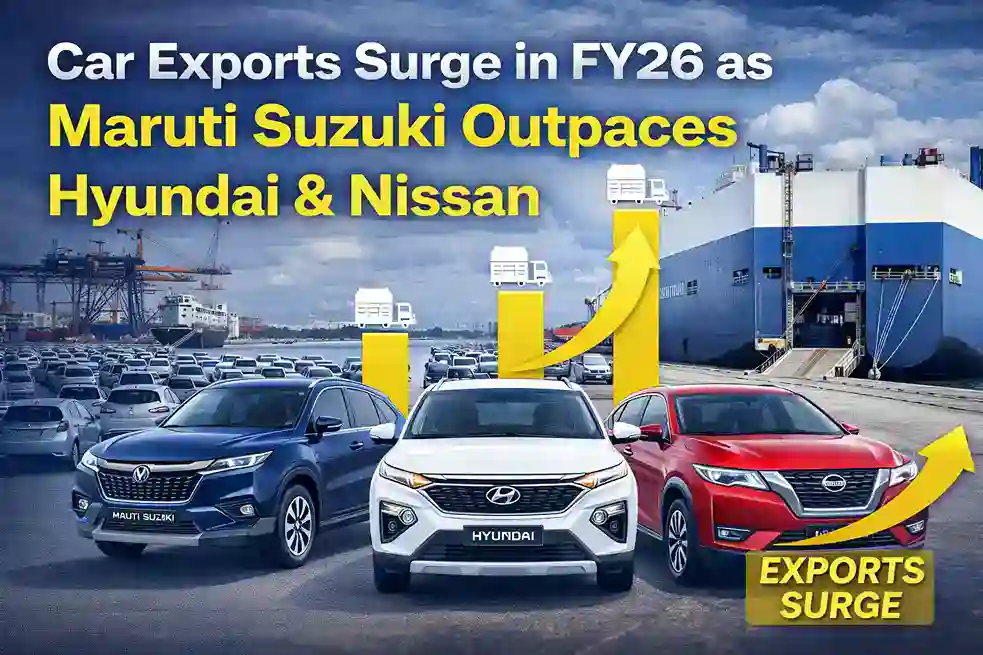
India’s automobile industry delivered a strong performance in FY26, with car exports recording a clear surge amid steady global demand and improved supply chains. Leading this growth was Maruti Suzuki, which widened its export lead and outpaced rivals like Hyundai and Nissan. The numbers underline a bigger story: India is no longer just a cost-efficient manufacturing base—it’s becoming a strategic export hub for compact cars and value-driven SUVs.
This article explains what drove the export surge in FY26, why Maruti Suzuki pulled ahead, and what it means for India’s auto future.
A Strong FY26 for Indian Car Exports
After a few years of pandemic-era disruptions and logistics bottlenecks, FY26 marked a return to momentum for vehicle exports. Indian carmakers benefited from:
Stabilized global shipping routes
Competitive production costs
Strong demand for fuel-efficient, compact vehicles
Increased acceptance of India-made models in new markets
Exports to regions such as Latin America, Africa, the Middle East, and parts of Southeast Asia showed notable growth, helping overall volumes climb.
Why Maruti Suzuki Led the Export Race
Maruti Suzuki’s leadership in FY26 exports wasn’t accidental—it was the result of long-term planning and scale advantages.
1) Product-Market Fit
Maruti’s portfolio aligns closely with what many emerging markets want: compact dimensions, high fuel efficiency, and proven reliability. Models built in India are tailored for varied road conditions and cost-sensitive buyers, making them export-ready with minimal changes.
2) Manufacturing Scale & Efficiency
With some of the largest production facilities in the country, Maruti benefits from economies of scale. Higher volumes reduce per-unit costs, allowing competitive pricing abroad without compromising margins.
3) Diverse Export Destinations
Maruti exports to over 100 countries, reducing dependence on any single market. This diversification cushioned the company against regional slowdowns and kept shipments steady throughout FY26.
4) Consistent Quality Standards
Strict quality controls and continuous process upgrades have helped Maruti meet international safety and emission requirements, a key factor for sustaining export growth.
Hyundai: Strong Presence, Tighter Competition
Hyundai remained a major exporter from India in FY26, supported by its long-standing export operations. The brand enjoys solid demand for well-equipped hatchbacks and compact SUVs, particularly in emerging markets.
However, Hyundai faced tighter competition on pricing and a more balanced focus between domestic sales and exports. While exports grew, the pace didn’t match Maruti Suzuki’s acceleration, leading to a narrower gap in some destinations but a wider one overall.
Also Read :- Up to ₹1.30 Lakh Discount on Maruti Suzuki Nexa Cars in Jan 2026 – Full Details

Nissan: Selective Growth Strategy
Nissan’s export numbers improved in FY26, but the brand followed a selective, model-specific approach. With fewer export-focused products compared to Maruti and Hyundai, Nissan’s growth was steady rather than explosive.
That said, India remains an important manufacturing base for Nissan, especially for right-hand-drive markets, and FY26 reinforced the company’s intent to leverage Indian plants for global supply.
Markets That Drove FY26 Growth
Several regions played a key role in lifting India’s export performance:
Latin America: Demand for compact sedans and hatchbacks remained strong
Africa: Reliability and low ownership costs favored India-made cars
Middle East: Fleet and budget segments saw renewed orders
Southeast Asia: Select markets absorbed fuel-efficient small cars
Indian manufacturers capitalized on these trends by offering cost-effective powertrains and simplified trims that met local needs.
Policy, Logistics, and the Export Ecosystem
FY26 also benefited from incremental policy support and improved port operations. Faster customs processing, better coordination at export hubs, and supplier localization helped reduce lead times.
Supplier maturity is another quiet advantage. A strong domestic components ecosystem allows Indian plants to scale exports quickly without relying heavily on imports, keeping costs predictable.
What This Means for Indian Buyers
Rising exports often raise a common concern: Will exports hurt domestic supply? In FY26, the answer was largely no. Higher plant utilization actually improved efficiencies, helping manufacturers balance domestic demand while shipping more cars abroad.
In the medium term, export success can translate into:
Better quality standards
Faster adoption of global features
Greater price stability due to scale benefits
The Road Ahead: Can the Momentum Continue?
Looking forward, sustaining export growth will depend on:
Continued competitiveness on costs
Meeting evolving global safety norms
Expanding into newer markets
Managing currency volatility
Maruti Suzuki appears well-positioned to maintain leadership, but Hyundai and Nissan are unlikely to stand still. New models, alternative powertrains, and refreshed export strategies could reshape rankings over the next few years.
Final Verdict
FY26 proved to be a breakout year for Indian car exports, with Maruti Suzuki firmly in the lead, outpacing Hyundai and Nissan through scale, efficiency, and market alignment. The surge highlights India’s growing stature as a global automotive exporter, not just a domestic powerhouse.
If manufacturers keep investing in quality, compliance, and product relevance, India’s export story is likely to get even stronger—benefiting companies, workers, and buyers alike.
Comments are closed.